A collaboration between Cummins Inc. and the Carbon Fiber Technology Facility (CFTF) at the Department of Energy’s Oak Ridge National Laboratory (ORNL) has resulted in the ability to produce enough filter media to supply more than a million face masks and respirators per day to U.S. healthcare facilities.
As a leading manufacturer of air, fuel and lube filtration products for heavy-duty diesel engines, Cummins began exploring ways to use their filtration production technology to support healthcare providers as they addressed the COVID-19 pandemic.
At the same time, ORNL was searching for ways to scale up production of face masks with equipment used to mass produce precursor material for carbon fiber production at the CFTF.
ORNL’s research team had been working with the inventor of N95 filter media, Dr. Peter Tsai, to develop a novel in-line charging device that could be placed on the precursor production line to electrostatically charge the melt-blown material made of polypropylene or PP. Melt blowing is a nonwoven process that makes microfibers into a fabric by extruding, drawing and scattering a polymer resin with high velocity air and making a randomly deposited sheet of fibrous material applicable for filtration. By electrostatically charging the material with millions of microfibers layered on top of each other, the filter can remove more than 95 percent of submicron particles and viruses like COVID-19.
ORNL’s Merlin Theodore, Director of the CFTF, said:
“We reached our target goal in only a few weeks on pilot scale melt blowing capability at the CFTF and had the capability to produce filter media for 9,000 masks per hour when we connected with Cummins for potential technology transfer and scale up. Cummins was an ideal partner to scale what we had accomplished and helped us produce material that passed all required testing for filter media.”
With a filtration site in Cookeville, Tennessee just a short drive from the CFTF’s Oak Ridge location, Holm said that ORNL was the right fit not only in proximity, but also in research expertise.
Holm said:
“We had the nation’s experts in material science and fiber technology located about an hour from our primary production location. And, as fate would have it, ORNL was already working with the inventor of N95, Dr. Peter Tsai. Their research has made it possible to be where we are today. We can manufacture material that has passed all the required testing for N95 filter media.”
Cummins and ORNL have a long collaborative history, having partnered to develop a method that repairs a diesel engine cylinder head on heavy-duty engines by additive manufacturing and creating a probe to optimize the engine efficiency among other projects.
The filter media project marks the first time Cummins has collaborated with the CFTF at ORNL.
Just two months ago, Cummins had never produced filter media for face masks and today the company has shipped material to multiple customers across the country for the production of millions of masks.
Holm said:
“We knew melt blowing, but we could not have gotten up-to-speed without the interactions with ORNL and Dr. Tsai. Their technical guidance helped us become operational in a short amount of time so that we could meet the demand and supply our customers with material during a time of crisis.”
ORNL’s research team designed and manufactured a custom electrostatic charging device for Cummins at the DOE’s Manufacturing Demonstration Facility at ORNL and assisted in the installation of the device on the company’s Cookeville facility production line.
“We’re now looking for opportunities to expand the scope and performance of the materials we’re making, so we can serve even broader needs in the future,”
Holm said. According to CFTF Director Theodore, industry collaborations like this are the reason national lab user facilities exist.
she said:
“Our goal is to transfer our technology to industry partners to increase U.S. competitiveness in manufacturing. This in turn supplies a critical need for our country, creates job growth and stimulates the economy. We are the catalyst that help industry bring technology to the consumer.”
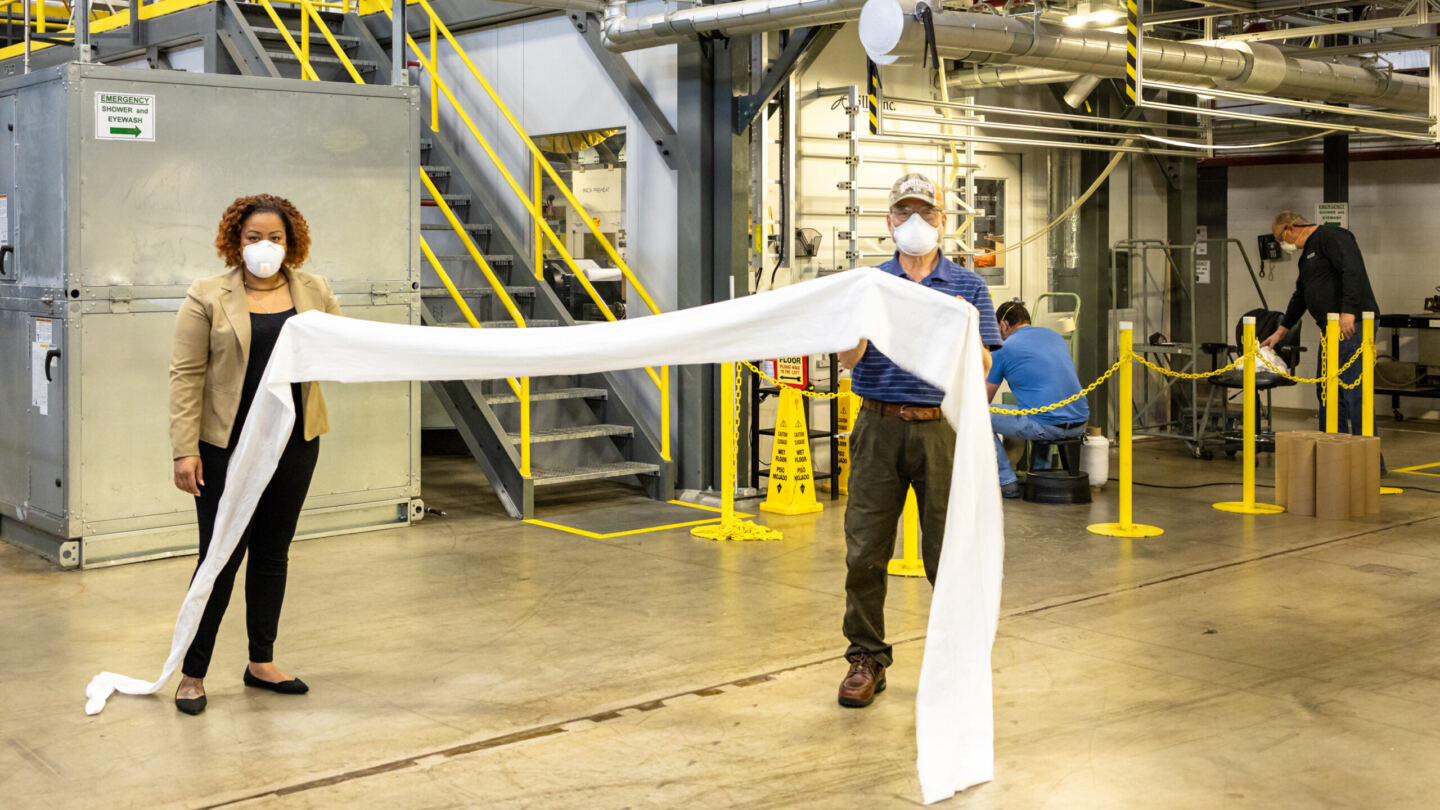
ORNL’s Merlin Theodore, Director of the CFTF and Dr. Peter Tsai, inventor of N95 filter media, holding a sample of the material. Photo Credit: Carlos Jones, ORNL, US Department of Energy. Courtesy of cummins.com
This website uses cookies to improve your experience. We'll assume you're ok with this, but you can opt-out if you wish.AcceptRead More
Privacy & Cookies Policy
Privacy Overview
This website uses cookies to improve your experience while you navigate through the website. Out of these, the cookies that are categorized as necessary are stored on your browser as they are essential for the working of basic functionalities of the website. We also use third-party cookies that help us analyze and understand how you use this website. These cookies will be stored in your browser only with your consent. You also have the option to opt-out of these cookies. But opting out of some of these cookies may affect your browsing experience.
Necessary cookies are absolutely essential for the website to function properly. This category only includes cookies that ensures basic functionalities and security features of the website. These cookies do not store any personal information.
Any cookies that may not be particularly necessary for the website to function and is used specifically to collect user personal data via analytics, ads, other embedded contents are termed as non-necessary cookies. It is mandatory to procure user consent prior to running these cookies on your website.
Cookies To make this site work properly, we sometimes place small data files called cookies on your device. Most big websites do this too.
Accept
Change Settings
Cookie Box Settings
Cookie Box Settings
Privacy settings
Decide which cookies you want to allow.
You can change these settings at any time. However, this can result in some functions no longer being available. For information on deleting the cookies, please consult your browser’s help function.
Learn more about the cookies we use.
With the slider, you can enable or disable different types of cookies:
This website will:
This website won't:
Remember which cookies group you accepted
Essential: Remember your cookie permission setting
Essential: Allow session cookies
Essential: Gather information you input into a contact forms, newsletter and other forms across all pages
Essential: Keep track of what you input in a shopping cart
Essential: Authenticate that you are logged into your user account
Essential: Remember language version you selected
Functionality: Remember social media settings
Functionality: Remember selected region and country
Analytics: Keep track of your visited pages and interaction taken
Analytics: Keep track about your location and region based on your IP number
Analytics: Keep track of the time spent on each page
Analytics: Increase the data quality of the statistics functions
Advertising: Tailor information and advertising to your interests based on e.g. the content you have visited before. (Currently we do not use targeting or targeting cookies.
Advertising: Gather personally identifiable information such as name and location
Essential: Remember your cookie permission setting
Essential: Allow session cookies
Essential: Gather information you input into a contact forms, newsletter and other forms across all pages
Essential: Keep track of what you input in a shopping cart
Essential: Authenticate that you are logged into your user account
Essential: Remember language version you selected
Functionality: Remember social media settings
Functionality: Remember selected region and country
Analytics: Keep track of your visited pages and interaction taken
Analytics: Keep track about your location and region based on your IP number
Analytics: Keep track of the time spent on each page
Analytics: Increase the data quality of the statistics functions
Advertising: Tailor information and advertising to your interests based on e.g. the content you have visited before. (Currently we do not use targeting or targeting cookies.
Advertising: Gather personally identifiable information such as name and location









 Copyright 2019 All rights reserved.