




Precision Disk 500T air drill is designed to help soybean producers add days to the growing season while new air cart configurations and planter features add capacity, agronomic benefits
As the 2021 planting season nears, growers are looking at how to drive efficiency, boost yields and make the most of their equipment investments. Case IH shares how to achieve early, consistent soybean emergence to drive yields, and provides equipment investment recommendations for growers to consider to maximize ROI on their operation this year. In addition, new configurations of Precision Air carts bring the largest capacity in the Case IH tow-between model lineup for greater in-field efficiency, while new features for 2000 series Early Riser planters enhance accuracy and minimize compaction.
Plant soybeans earlier to maximize yield potential
While many growers prioritize planting corn before soybeans, studies from the University of Illinois at Urbana-Champaign show that planting soybeans earlier can be critical to maximizing yield potential. When soybeans are planted early, they reach stage V1 earlier, resulting in more potential pods and seeds per acre.
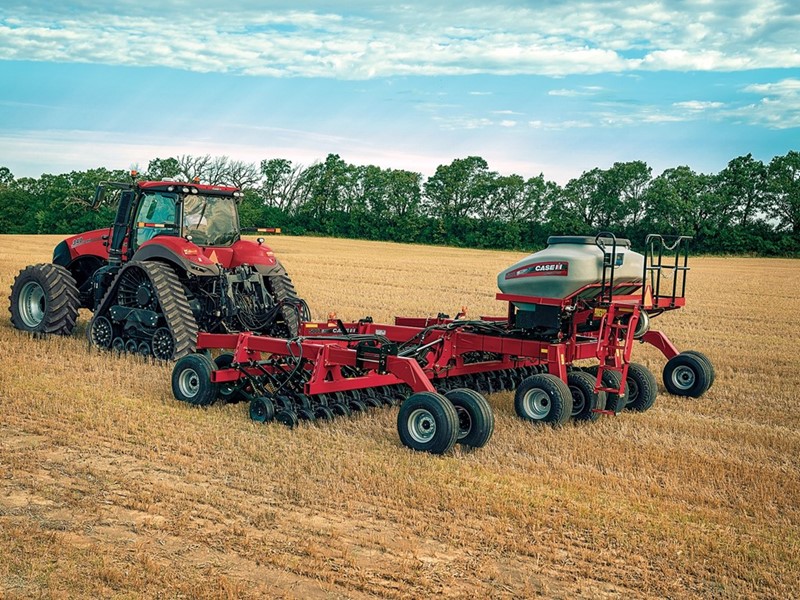
One effective way producers growing both corn and soybeans can expand soybean-planting windows is by adding a lower-investment, high-efficiency air drill to their operation. The Case IH Precision Disk 500T single disk, single-rank air drill, for example, is an ideal option to help plant soybeans earlier or into tough no-till seedbeds — all while maximizing ROI.
“For years, growers have traditionally prioritized planting corn before soybeans. Recent studies showing the significant benefits of early soybean planting, however, are causing some producers to reconsider their planting practices and plant soybean crops earlier. Adding an air drill to a producer’s operation for soybean seeding can add valuable days to the growing season,”
said Trent Nowosad, Case IH marketing manager for seeding equipment.
Late-emerging soybeans can be costly
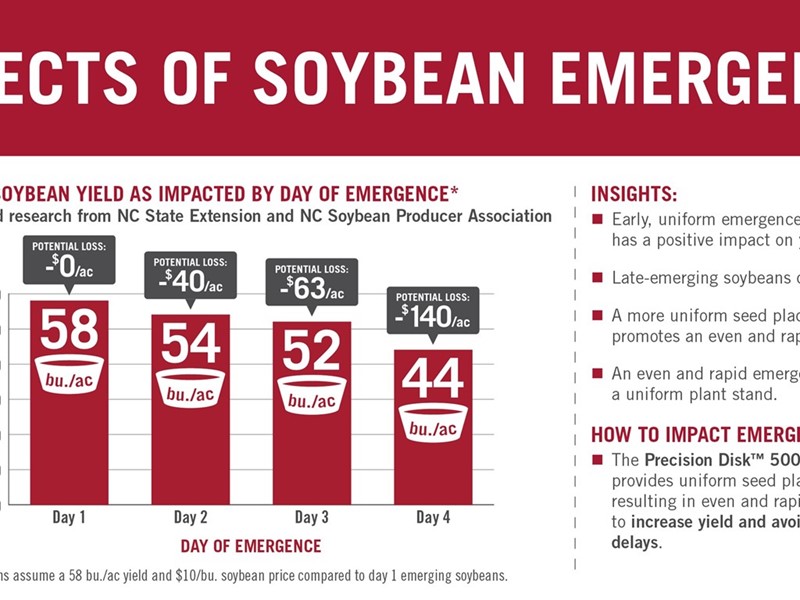
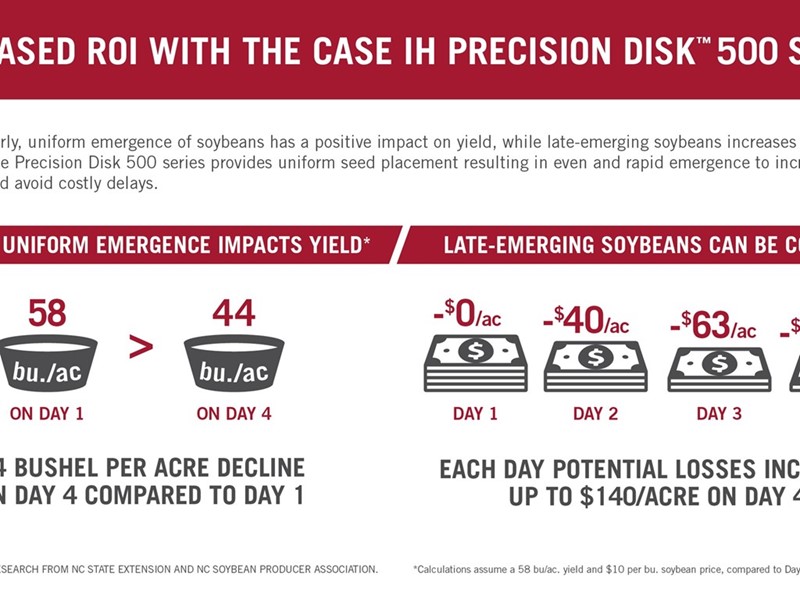
In addition to earlier planting, key drivers to soybean yields that producers have control over are accurate seed placement and consistent emergence. Studies from North Carolina State University and the North Carolina Soybean Producers Association show that late-emerging soybeans can be costly — with a potential loss of up to $140 per acre when soybeans are just four days behind. Case IH Precision Disk 500T single disk, single-rank air drills are designed to deliver the most accurate seed placement in the industry, allowing growers to set up their soybean crop for success and help plants emerge earlier and more consistently to boost yields.
Case IH Precision Disk 500T single disk, single-rank air drills are agronomically designed with a parallel link row unit — a feature that sets this model apart from competitors. This row-unit is built to efficiently cut through residue, open a uniform seed trench, accurately deliver the seed and effectively close the trench. For growers looking for a soybean-special air drill, a single-rank configuration with 15-inch spacing is now available for the Model Year 2021 Precision Disk 500T.
“With the Case IH Precision Disk 500T single disk air drill, producers don’t have to sacrifice accuracy and agronomic performance for efficiency. Each feature and component is designed to contribute to earlier, more-uniform emergence to help growers boost their bottom lines,”
Nowosad said.
New Precision Air 5 series air cart models
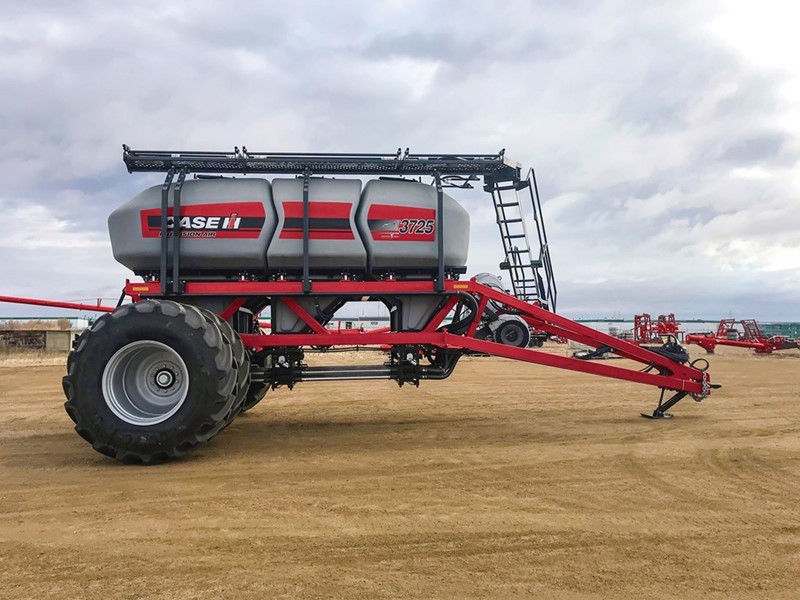
Delivering more capacity to help small grain producers make the most of their time in the field, Case IH is expanding the Precision Air 5 series air cart lineup with two new wide-bodies, tow-between models. The new Precision Air 3725 offers a capacity of 725 bushels, while the Precision Air 4765 carries 760 bushels — the largest capacity in the Case IH tow-between model lineup.
Each new model features a three-tank design, while the Precision Air 4765 air cart also is equipped with an auxiliary tank. The new models are available with a hydraulic jack to raise and lower the air cart, making it easy to hook up to the tractor, even when the cart is fully loaded. A multiposition rear hitch allows for proper drill height for added flexibility, accommodating varying types of drills.
Case IH also offers a new rice roller, available on all Model Year 2021 Precision Air 5 series air carts. Designed to meter both hybrid and conventional rice with unmatched accuracy, this option is available to order factory-installed. Current owners of Precision Air 5 series air carts can install the roller on their current models.
New features for Early Riser planter
To help producers achieve accurate seed placement, Case IH is offering the Precision Planting WaveVision seed sensor as a factory-fit option for the 2000 series Early Riser planter. Available for Model Year 2022, this feature is especially valuable for growers in high-dust or extreme residue conditions where a standard optical sensor might provide erratic feedback due to interference.
In addition, Case IH offers a 2×2 frame-mounted liquid fertilizer factory-fit for Model Year 2022, ideal for growers looking for precise placement of starter fertilizer with their planter pass. Available for 2160 Early Riser planters, new track offerings include a 24-inch-wide track spaced at a gauge width of 132 inches to help growers minimize compaction.
Seed System-Tank
Lid & Opening
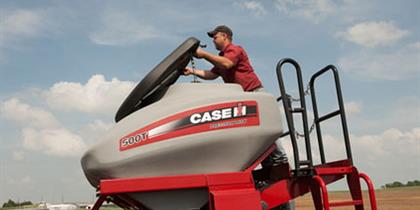
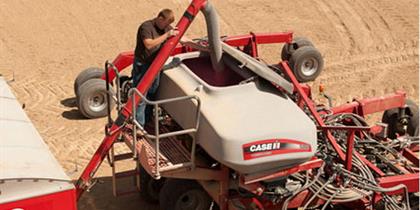
The Roto-molded tank and tank lid are made of durable polyethylene plastic for high strength and long life.
The tank opening is 2 ft x 4 ft, making it easy to fill the tank without pushing material around by hand.
Two rubber latches hold the lid in place to prevent any water or debris from entering the tank when the lid is closed.
Tanks Accessing/Filling/Cleaning
The operator can easily access the rear of the tank via a ladder and rear platform.
Access to the tank with a bulk seed caddy auger is simple, an opening in the rear railing is provided to allow the auger to fit through and access the tank opening.
A tank clean-out chute is found on each rear side of the tank.
100 bu Tank has four clean-out locations.
These chutes allow nearly 100% clean-out of the tank.
Tank Inner Slope
Designed for 100% cleanout as the product empties out of the tank
The front and rear slope angle is over 35 degrees while the slides of the tank are over 50 degrees.
The side directs the product directly down into the meter and will completely empty out.
Capacity
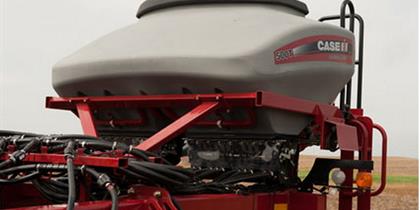
The integrated tank provides up to 70 bu or 100 bu (depending on configuration) of onboard storage for a single product.
25 ft and 30 ft widths: 70 bu
40 ft width: 100 bu
Seed Level Sensors
Located on either side of the mounted tank, towards the rear
Can be placed in one of three locations depending on the preference of the operator: Low, Medium, or High
Provide valuable feedback as the seed level inside the tank drops
A warning appears on the display when the seed level drops below the sensor level
Agitator
The opening between the tank and meter assuring the product continues to flow into the meter to provide precise seed rates and maximum uptime.
No additional lubrication of the product should be required.
Seed System-Meter
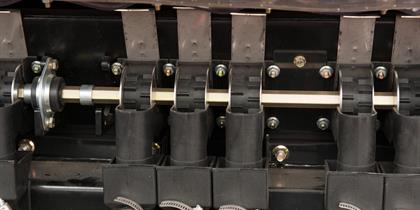
Roller Operation
Each roller is constantly exposed to the seed supply in the tank and the rate is adjusted by turning the roller faster or slower, providing accurate seeding rates
The Disk Drill is often (incorrectly) compared to a box drill. A box drill adjusts a gate that will block off more or less of the opening between the meter and seed supply to adjust rates
The opening between the meter and roller can be adjusted, it stays in one location for each crop type and the meter speed is adjusted for rate control
Seed Delivery
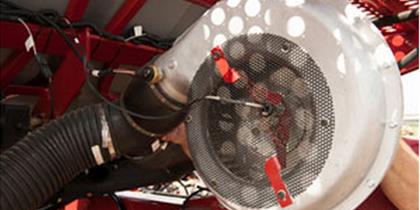
A single 6-inch fan provides all the needed air for seed delivery to the row-unit openers
The AFS Pro 700 provides feedback on the air pressure provided
The operator simply adjusts the hydraulic oil flow rate from the tractor remote valve to adjust the air pressure rate
Proper air pressure level is determined by an open line test
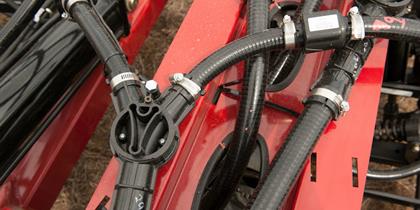
The seed gently travels down the primary UV- resistant tube to a Y-splitter where it evenly divides the seed between two openers
The splitter has three different position settings to direct seed: Front & rear rank, Single Run – Rear rank, Single Run- Front rank
Seed Drive Calibration
The AFS Pro 700 provides the ability to quickly and easily calibrate the meter drives for accurate population control for each crop type
The purpose of the calibration is to understand the amount of product applied by a given number of meter rotations
The process performed through a series of steps via a wizard
A calibration number is automatically created for the product being applied
The operator can change this manually if desired
The value is not saved between each crop type and must be re-entered before returning to seeding the original crop type
Accurate Seeding Rates
On-board seed meter provides accurate seed metering across a broad range of seed types
The meter itself consists of individual meter roller sections for each primary run and then the seed flow is split by a Y-splitter and is directed to one of two different openers
Each roller section is made from a durable polypropylene material that is able to withstand all types of treatments and seed coatings
Seed Meter Roller Selection
Extra fine
Fine
Course
Many crops can be seeded with each seed meter roller type but require calibration and validation that the correct rate is being applied
Seed Meter Changing
Remove the current door/meter assembly and install the new roller/door assembly.
The assemblies are removed by simply unscrewing two bolts on each side of the meter.
The seed must be drained from the tank prior to removing the meter assembly.
Seed Drive
The single hydraulic motor provides the needed power and torque to turn the seed drives at the required speed for precise rate control
The sprocket combination can be changed to achieve the proper meter speed range for a seed type
Meter speed should be kept between 15 and 110 rpms
The built-in speed sensor provides the needed feedback to control motor speed
Rate control is easily performed through the AFS Pro 700 display. Choosing one of the three user defined preset rate buttons on the right hand side of the display will change the rate
Because the meters are hydraulically driven, they not be primed prior to seeding
A button on the right hand side of the display is available to prime the meter prior to field operation
Hydraulic Work Switch
An optional work switch is available to activate the mounted tank seed meter
The work switch makes operation much easier because it automatically turns the meters on and off and starts/stops acres counting when the tool changes work position
If no work switch is installed, the operator must manually switch the meters on and off via a button on the display
GPS Speed Sensor
An optional GPS Speed Sensor Kit is available to provide ground speed via a DIA kit
Uses GPS signals to output a ground speed signal
The speed sensor is required if the tractor is not equipped with either a ISO11783 tractor ECU (included with a ISO11783 complete tractor), or a third party GPS source (receiver or display output) that ground speed can be taken from
Rain Shield Kit
The optional, clear rain shield kit protects the seed meters from rain and water in case the disk drill is left outside
Seed Monitoring
Seeding Success on Board
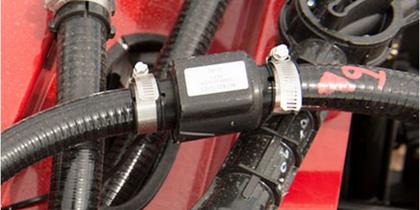
Seed Sensor
AFS Display Information-Bar Graph
Shows the relative amount of seed being applied compared to the other runs and how close that run is flowing compared to the desired rate (green line)
If a run is blocked or no seed is flowing, the bar graph will be empty
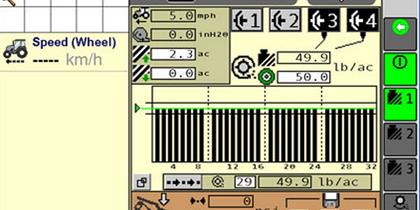
AFS Display Information-Blockage Sensing
Can easily be viewed by pressing a button on the display
Shows blockage of every sensor
AFS Display Information- Individual Meter Rate
Displayed in a number (lb/ac or sds/ac) format
To read sds/ac the number of seeds per lb. must be known
This display will cycle through each run unless the operator presses the hold button or enters in the desired run via the keypad and stops the cycling report
AFS Display Information
- Shows the relative amount of seed being applied compared to the other runs and how close that run is flowing compared to the desired rate (green line)
- If a run is blocked or no seed is flowing, the bar graph will be empty
Individual Meter Rate
- Displayed in a number (lb/ac or SDS/ac) format
- To read sds/ac the number of seeds per lb. must be known
- This display will cycle through each run unless the operator presses the hold button or enters in the desired run via the keypad and stops the cycling report
Blockage
- Can easily be viewed by pressing a button on the display
- Shows blockage of every senso

 Copyright 2019 All rights reserved.